Deep Dive Sourcing Intelligence
Key Engineering Criteria When Importing Chinese Porcelain Dinnerware
1. High-Alumina Body Formulations and Edge-Chip Dynamics
The primary point of failure in commercial tableware is rim damage caused by contact in commercial dish racks, bus boxes, and plating lines. High-grade Chinese porcelain dinnerware overcomes this issue by boosting aluminum oxide (Al₂O₃) content to 15% - 25% within the refined clay slip. When fired under precise atmosphere-controlled tunnel kilns, alumina reacts with silica to form dense mullite crystals.
This crystalline framework dramatically improves impact resistance (measured in Joules via pendulum impact testing equipment). Furthermore, specification designers utilize "Reinforced Edge Rolls"—a subtle radius added to the perimeter underside—to redistribute point-impact energy across the entire plate body, reducing chipping risks by up to 60% compared to sharp-edged domestic profiles.
2. Thermal Shock Endurance and Microwave / Oven Safety
Hospitality kitchens move food directly from cold storage or blast chillers into high-heat salamanders, convection ovens, or microwave units, followed immediately by rapid plating and subsequent high-temperature washing. Ceramics with poor thermal expansion coefficients suffer structural fatigue, manifesting as fine spiderweb cracking (crazing) or sudden catastrophic fracturing.
Vitrified Chinese porcelain dinnerware engineered for B2B supply undergoes rigorous thermal shock testing: items are heated to 180°C – 200°C in an oven and quenched instantly into 20°C ice water. Zero structural degradation occurs because the thermal expansion of the glaze perfectly matches the contraction rate of the underlying ceramic body.
3. Glaze Hardness, Metal Marking Resistance, and Hygiene Standards
Dark lines appearing on white dinnerware over time are frequently misidentified as glaze scratches. In reality, they are metal deposits transferred from soft stainless-steel cutlery onto a glaze surface that lacks adequate Mohs hardness. High-fired commercial glazes achieve a hardness rating of 6.5 to 7 on the Mohs scale—harder than standard commercial flatware steel.
From an epidemiological and hygiene perspective, non-porous glazed surfaces (water absorption under 0.1%) are imperative. Pores in low-fired ceramics absorb moisture, oils, grease, and cleaning chemicals, creating breeding grounds for bacteria and causing unpleasant odor retention. Fully vitrified Chinese porcelain guarantees absolute impermeability, passing global public health and sanitation inspections effortless.
4. Ergonomics, Stacking Stability, and Back-of-House Storage Efficiency
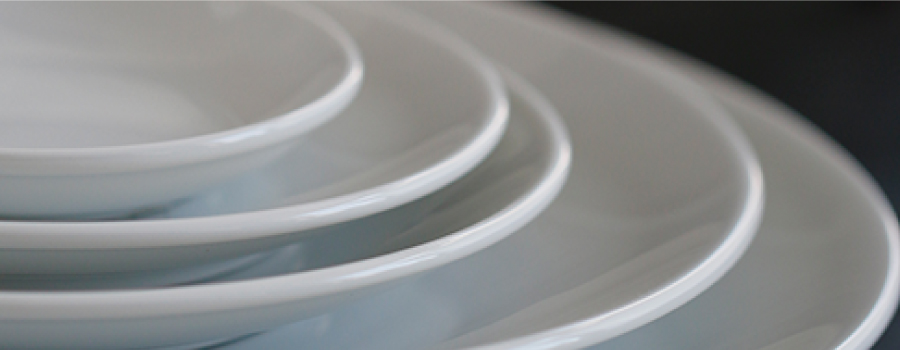
For banquet managers overseeing events with thousands of covers, back-of-house logistics dictate operational speed. Plates that wobble, interlock unevenly, or slide during transport increase breakage and slow down clearing routines. High-performance dinnerware lines feature normalized foot rims with precise locking clearances. This design ensures vertical stability up to 30-plate stack heights while protecting lower glaze surfaces from foot abrasions.