
PATRA  |  Porcelain & Bone China Tableware Manufacturer since 1982 — Bangkok, Thailand
0%

Global buyers need more than attractive tableware photos when evaluating China’s bone china manufacturers. Bone china deep plates combine refined appearance, light weight, strength, and practical serving depth. Their soft white body can make sauces, desserts, and colorful dishes look more vivid. Yet quality depends on more than the material name. Firing control, glaze consistency, rim finishing, and dimensional accuracy all matter. This guide introduces reliable Chinese suppliers for buyers seeking stable quality and long-term cooperation.

Experienced suppliers usually provide clear product specifications, sample development, and factory communication. Buyers should examine plate weight, diameter, depth, stacking performance, and glaze smoothness. A well-made rim should feel comfortable, without sharp edges or visible pinholes. Surface color should remain consistent under different lighting. Food-contact documentation and applicable testing records also deserve careful review. Requirements may differ between the European Union, North America, and other markets. Responsible suppliers explain these differences instead of making vague promises.

Packaging is equally important. Dividers, protective sleeves, and reinforced cartons can reduce breakage during international transport. Buyers should request drop-test details and inspect trial shipments before placing large orders. Custom logos, colors, and gift packaging may be available, but every change needs written confirmation. No supplier is perfect. A polished catalog can hide production limits, slow communication, or inconsistent replacement policies. That is why this overview considers evidence, not only claims. It highlights manufacturers with practical experience, transparent processes, and dependable export support. Some specifications may still require refinement after sampling, and honest evaluation remains essential.
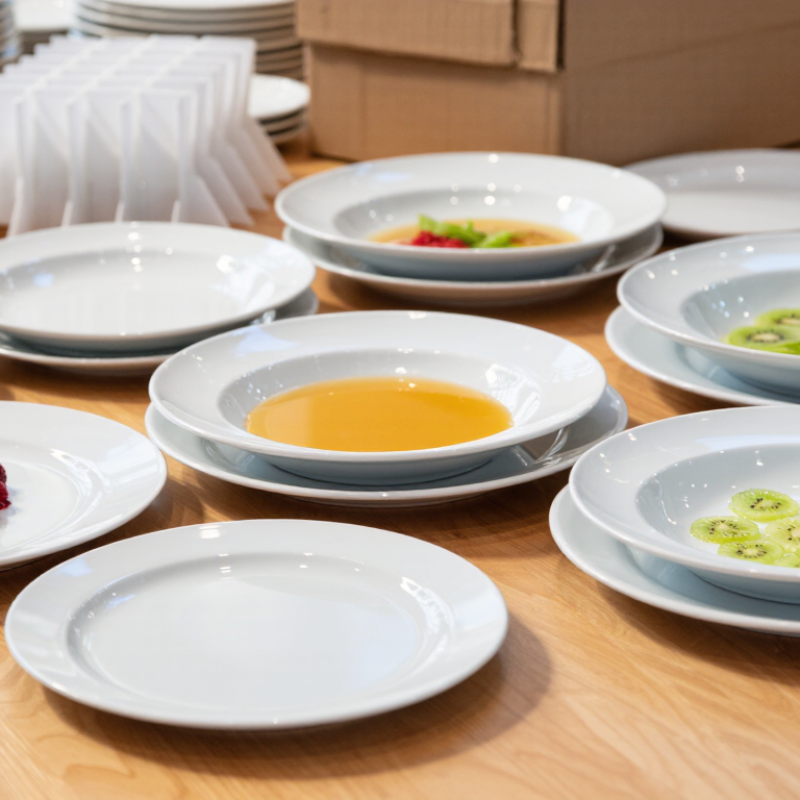
China Top Bone China Deep Plates Suppliers for Global Buyers

Bone China Deep Plates: Definition, Features, and Global Applications

Bone china deep plates combine refined appearance with practical depth. Bone china is a porcelain-type ceramic containing calcined animal bone ash, feldspathic material, and kaolin. The bone ash improves translucency, whiteness, and resistance to chipping. It feels lighter than many stoneware plates.

A deep plate usually has a broad rim and a recessed center, often measuring 20–24 centimeters across. Its depth supports pasta, curry, soup, rice dishes, and sauced vegetables without messy spills. The smooth surface helps chefs present food clearly. It also makes portion control easier in hotels and restaurants. However, “bone china” quality is not identical across factories. Buyers should verify bone-ash content, firing temperature, water absorption, glaze hardness, and dishwasher testing through inspection records.

Market data shows why this category attracts international buyers. Grand View Research estimated the global ceramic tableware market at about USD 10.5 billion in 2022, with continued growth expected through 2030. Fortune Business Insights valued the broader global tableware market at roughly USD 44.2 billion in 2023. These reports combine several materials, so they do not isolate bone china accurately. That limitation matters.

For China-based sourcing, request sample plates, edge-impact tests, dimensional tolerances, and food-contact compliance documents. A low quotation may hide higher breakage, uneven glaze, or inconsistent color. Details matter. Export packaging should use molded separators, corner protection, and moisture-resistant cartons. One overlooked test can damage an otherwise excellent supply program.

China’s Leading Bone China Deep Plate Supplier Regions

China’s leading bone china deep plate supplier regions are shaped by different production strengths. Tangshan in Hebei is widely recognized for tableware manufacturing and mature bone china processing. Its factories often provide stable firing control, smooth glazing, and consistent plate thickness. Buyers can usually discuss hotel, restaurant, and household specifications with experienced technical teams.

Chaozhou in Guangdong has a dense ceramic supply network, from clay preparation to decoration and final packing. This concentration can shorten sourcing distances and support flexible order quantities. Many workshops produce deep plates with practical rims, reinforced feet, and stackable profiles. Sample inspection remains important because surface quality may vary between factories. The region is efficient, but not every supplier offers the same quality discipline.

Jingdezhen in Jiangxi contributes strong porcelain craftsmanship and detailed decorative experience. Some suppliers there develop bone china collections with refined shapes and fine printed patterns. However, buyers should confirm the actual material composition before comparing prices. A bright appearance does not prove genuine bone china. Ask for laboratory data, firing specifications, food-contact test documents, and production samples. No region is perfect. A useful sourcing decision should balance factory experience, inspection access, transport costs, and communication speed. Suppliers near major ceramic clusters may react quickly, yet their quality systems still need independent verification.

How to Evaluate Bone China Deep Plate Suppliers in China

When evaluating bone china deep plate suppliers in China, begin with material evidence, not polished catalogs. Ask for the bone ash percentage, firing temperature, glaze composition, and batch traceability. Grand View Research’s 2024 tableware analysis identifies ceramics as a leading material segment, but this broad category includes ordinary porcelain. A supplier must prove that its product is genuinely bone china. Request laboratory reports for whiteness, water absorption, thermal shock, and lead and cadmium release. ISO 6486 provides a recognized method for testing ceramic food-contact articles.

Audit the factory’s real production capacity. Review kiln records, molding equipment, glaze inspection, and packing procedures. China Customs trade statistics show China remains a major exporter of ceramic tableware, so export experience alone is not enough. Check recent shipment records, defect rates, replacement policies, and average lead times. Ask for a pre-production sample and a production sample from the same order. Sample before scaling. Small differences in rim thickness can affect stacking, breakage, and dishwasher performance.

Pricing needs careful interpretation. A low quotation may exclude tooling, inner packaging, testing, or breakage allowances. The International Trade Centre’s trade data can help compare China’s export patterns with other sourcing markets, but it cannot verify one factory’s quality. That limitation matters. A supplier may pass a paper audit and still struggle with consistent glaze color. I would also inspect the loading area, not only the showroom. Numbers can mislead. Reliable evaluation combines documents, physical samples, third-party testing, and repeated communication with the production team.

China Top Bone China Deep Plates Suppliers for Global Buyers - How to Evaluate Bone China Deep Plate Suppliers in China

Evaluation Dimension Recommended Benchmark How Global Buyers Can Verify Commercial Importance Suggested Weight
Bone China Composition Traditional bone china commonly contains at least 30% bone ash, with many commercial formulations using approximately 30%–50% bone ash. Request a material specification, formulation statement, and an independent laboratory composition report for the production batch. Confirms that the product is bone china rather than standard porcelain or vitrified ceramic. 15%
Product Dimensions Typical deep plates are approximately 20–26 cm in diameter, with a depth of about 3–5 cm, depending on the intended use. Approve a dimensioned drawing and measure pre-production samples using calibrated tools. Accurate dimensions support menu planning, stacking, shipping calculations, and compatibility with existing tableware. 8%
Capacity and Usable Volume A common capacity range for bone china deep plates is approximately 500–900 ml, subject to diameter, depth, and rim design. Fill a sample with water to the specified level and record the measured capacity before approval. Helps buyers select the correct format for soup, pasta, rice dishes, desserts, or hospitality service. 6%
Firing and Vitrification Bone china is generally fired at high temperatures, commonly around 1,200–1,250°C, although the exact schedule depends on the formulation and glaze system. Request the technical firing profile, production records, and test results for water absorption and glaze stability. Proper firing contributes to translucency, strength, low porosity, and resistance to staining. 10%
Water Absorption High-quality vitrified bone china should have very low water absorption; buyers commonly request a laboratory result of no more than 0.5% for the finished body. Obtain a test report using a recognized ceramic water-absorption method and confirm the tested sample matches the supplied product. Low absorption improves hygiene, durability, and resistance to odor or liquid penetration. 10%
Mechanical Strength The supplier should provide results for breaking strength, impact resistance, or comparable finished-product durability tests. Review laboratory reports and conduct drop, edge-impact, and stacking tests on randomly selected samples. Important for restaurants, hotels, catering operations, and retail products exposed to frequent handling. 10%
Glaze and Surface Quality The surface should be smooth, evenly glazed, free from pinholes, blisters, crawling, cracks, sharp edges, and visible warpage. Define an approved visual standard with defect limits, color references, inspection lighting, and acceptable quality limits. Directly affects presentation, cleaning performance, customer complaints, and retail acceptance. 12%
Food-Contact Safety Finished tableware should comply with the destination market’s limits for lead and cadmium migration and other applicable food-contact requirements. Request current third-party reports, such as testing based on ISO 6486 or the relevant regulations of the importing country. Required for lawful import, safe use, customs clearance, and protection of the buyer’s reputation. 15%
Thermal Performance The supplier should clearly state whether the deep plate is suitable for microwave, dishwasher, oven, or freezer use; suitability must not be assumed. Request written usage instructions and conduct repeated heating, cooling, and dishwasher-cycle tests where applicable. Prevents thermal-shock damage and reduces misuse-related returns. 6%
Customization Capability The supplier should support custom dimensions, rim profiles, colors, decals, embossing, packaging, and private-label requirements where needed. Review mold-development procedures, sample approval stages, decoration tolerances, and tooling ownership terms. Determines whether the supplier can support differentiated product lines and repeat orders. 5%
Minimum Order Quantity For customized ceramic tableware, initial MOQs commonly range from approximately 500 to 3,000 pieces per design, depending on tooling and decoration requirements. Obtain a written quotation showing MOQ by size, color, decoration, packaging format, and reorder quantity. Affects inventory investment, cash flow, product testing, and market-entry risk. 5%
Production Lead Time A typical production window is approximately 30–60 days after artwork, specifications, deposit, and sample approval; custom molds may require additional time. Request a milestone schedule covering tooling, sampling, mass production, inspection, packing, and shipment readiness. Supports reliable launch planning and replenishment for international buyers. 4%
Export Packaging Packaging should include protective separators, suitable inner cartons, moisture-resistant outer cartons, and clear carton identification for fragile goods. Approve a packing specification and perform a pre-shipment carton-drop or transport simulation test when commercially justified. Reduces breakage, insurance claims, replacement costs, and delivery disputes. 4%
Pre-Shipment Inspection Inspection should cover quantity, dimensions, color consistency, glaze defects, decoration placement, packing quality, and test samples. Use an agreed inspection checklist and sampling plan before final payment or shipment release. Creates objective evidence for quality acceptance and helps control batch-to-batch variation. 5%
Buyer Note: The quantity, capacity, MOQ, lead-time, and temperature figures are practical market benchmarks rather than guarantees. Final requirements should be confirmed through approved samples, written specifications, and destination-market compliance testing.

Manufacturing Standards, Quality Control, and Certification Requirements

Global buyers of bone china deep plates need more than polished photographs and attractive prices. Manufacturing discipline matters. Fortune Business Insights reported that the global ceramic tableware market reached about USD 10.95 billion in 2023, with continued growth projected through 2032. This expansion increases supplier competition, but it also raises inspection risks.

Reliable factories should control clay composition, firing temperature, glaze thickness, and plate warpage. Bone ash content must remain consistent between batches. A deep plate should sit flat, without rocking on a level surface. Inspectors should measure diameter, depth, weight, and rim deformation. Small differences can affect stacking and restaurant storage.

Food-contact compliance requires documented testing. For European shipments, suppliers should address Regulation (EC) No. 1935/2004 and ceramic lead and cadmium migration requirements under Directive 84/500/EEC and its amendments. For the United States, buyers commonly request testing aligned with FDA food-contact requirements. ISO 6486 test methods can support heavy-metal migration verification. ISO 9001 certification is useful, but it does not replace product testing.

Quality records should include batch numbers, kiln temperature logs, glaze inspection results, and independent laboratory reports. Packaging also needs attention. Deep plates require molded separators, corner protection, and drop testing. A certificate alone proves little. Supplier audits still matter. In practice, some factories present excellent samples but weaker mass production. Buyers should compare pre-shipment samples with random cartons. No system is perfect; even experienced teams can miss subtle glaze pinholes or uneven rims.

China Top Bone China Deep Plates Suppliers for Global Buyers

Manufacturing standards, quality control, and certification reference frameworks

The chart compares the number of major reference frameworks commonly reviewed by international buyers: China’s GB 4806.4-2016 for food-contact ceramic products; the European Union’s Regulation (EC) No 1935/2004 and Regulation (EC) No 2023/2006; the U.S. FDA 21 CFR 175.300; and ISO 9001:2015 and ISO 14001:2015 for quality and environmental management. These references are compliance benchmarks, not supplier certification claims.

Ordering, Customization, Pricing, and Export Considerations for Global Buyers

China Top Bone China Deep Plates Suppliers for Global Buyers

Ordering bone china deep plates from China requires more than comparing factory quotes. Ask for a physical sample before approving bulk production. Check the plate’s diameter, depth, rim shape, glaze smoothness, and stacking stability. A sample may look excellent, yet reveal uneven edges under restaurant lighting. It happens.

Customization can include color, logo placement, relief patterns, packaging, and carton labeling. Provide drawings with exact measurements and acceptable color differences. Custom molds usually increase tooling costs and extend lead times. Confirm whether the mold remains your property after production. This detail is easy to miss. A small trial order can expose design problems before larger commitments.

Pricing depends on material grade, size, decoration, order quantity, packaging, inspection, and delivery terms. Request a clear quotation showing tooling, sample fees, export packing, and inland transport separately. The cheapest offer may exclude protective dividers or replacement pieces. That creates avoidable losses. For export, confirm commercial invoices, packing lists, certificates, carton marks, and the selected Incoterm. Verify container loading plans, moisture protection, and breakage procedures with the supplier. Lead times should cover approval, production, inspection, and shipping delays. Build in extra days. Ports and peak seasons can disrupt careful schedules. Independent inspections are useful, but they do not replace precise specifications and written quality standards.

FAQS

Which Chinese regions are known for bone china deep plate production?

Northern, southern, and eastern ceramic regions offer different strengths. One area emphasizes stable firing, another supports flexible orders, and another focuses on decoration.

What makes one production region suitable for restaurant orders?

Look for steady plate thickness, smooth glazing, reinforced feet, and stackable profiles. Transport distance and communication speed also matter.

Can a bright plate surface prove genuine bone china?

No. Appearance alone proves little. Request material composition data, laboratory reports, production samples, and firing specifications.

What measurements should buyers check during inspection?

Measure diameter, depth, weight, and rim deformation. Place each plate on a flat surface. It should not rock.

Which quality problems can affect deep plate performance?

Warpage, uneven rims, glaze pinholes, and inconsistent thickness can cause stacking problems. Small defects become obvious in busy kitchens.

What documents support food-contact compliance?

Request heavy-metal migration tests and food-contact documentation for the destination market. General quality certification does not replace product testing.

How should buyers compare samples with mass production?

Compare approved samples with random cartons before shipment. Some factories produce excellent samples but weaker large batches.

What packaging protects deep plates during transport?

Use molded separators, corner protection, and drop testing. Deep plates need firm support because their rims can chip easily.

Are ceramic production clusters automatically reliable?

No. Clusters may shorten sourcing distances and improve response speed. Quality discipline still requires audits and independent verification.

What is an often-overlooked sourcing risk?

Buyers may trust certificates too quickly. A document helps, but inspection records and random checks reveal more. Samples still lie.

Conclusion

Bone china deep plates combine lightweight strength, refined translucency, smooth surfaces, and elegant presentation, making them suitable for restaurants, hotels, catering services, retailers, and household dining. This article introduces their main features and explains how different production regions in China support global supply through specialized manufacturing capabilities, skilled craftsmanship, and organized export services.

For international buyers, selecting a reliable supplier requires careful evaluation of production experience, material consistency, quality control systems, testing procedures, and relevant food-contact certifications. The article also discusses manufacturing standards, inspection requirements, customization options, packaging, minimum order quantities, pricing factors, delivery schedules, and export documentation. By comparing supplier capabilities and confirming product specifications in advance, buyers can reduce sourcing risks, achieve stable quality, and develop bone china deep plates that match their functional, aesthetic, and commercial needs in different markets.

Amelia

Amelia

Amelia is a professional marketing specialist with a strong understanding of the company’s products, services, and customer needs. Through her practical industry knowledge and thoughtful communication style, she helps readers discover how the company’s solutions can support more efficient,......