
Selecting a porcelain supplier for a hotel, restaurant, or event venue takes more than comparing catalog photos. Banquet porcelain plates must look refined under warm lighting and hold up through repeated service, washing, and storage. A thin gold rim may suit a formal wedding, while a plain white finish can work better for frequent use. Small details matter.
This guide introduces ten Chinese manufacturers and the qualities buyers may want to examine. It considers product ranges, customization options, production experience, quality-control practices, order quantities, and communication. These details help readers ask clearer questions before requesting samples or quotations. A polished website alone is not proof of consistent production. Ask about glaze consistency, edge strength, packaging, and replacement policies. Where available, review relevant test reports and confirm what they cover. Still, no checklist catches everything. Samples can reveal uneven color or a finish that feels different from its photograph. Lead times may also change with design complexity and order volume. That judgment can be hard.
The companies featured here are not a universal ranking for every buyer. The right choice depends on budget, service style, delivery needs, and the level of customization required. Use the profiles as a starting point, then verify current specifications directly with each supplier. A little extra checking can prevent an attractive plate from becoming an impractical purchase.
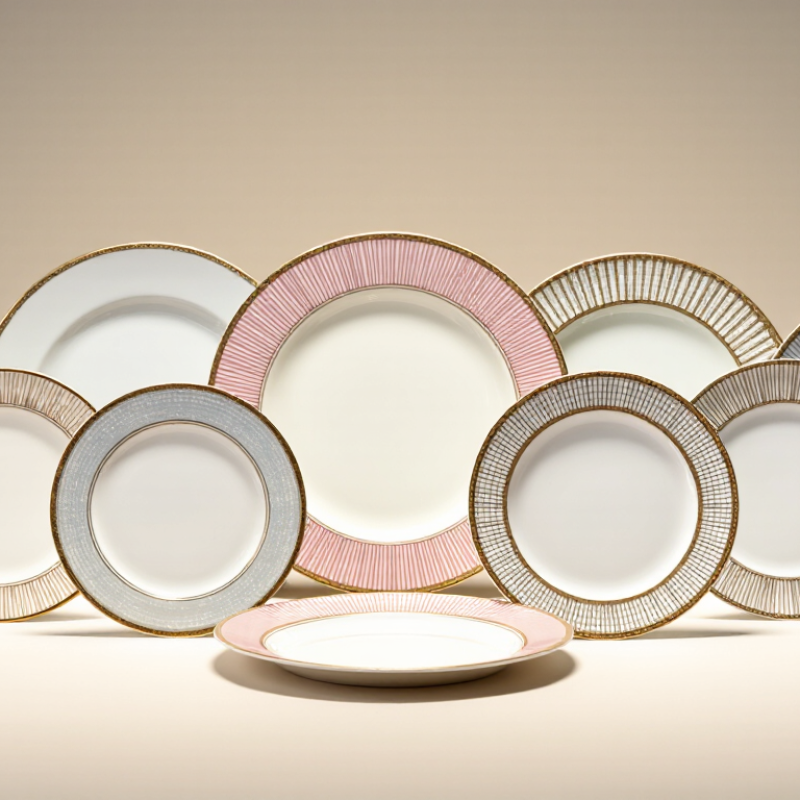
A banquet porcelain plate manufacturer in China is defined by repeatable performance, not attractive samples alone. The factory should control clay composition, forming pressure, firing curves, glaze thickness, and final inspection. A plate may look flawless under showroom lights. It can still warp during service.
Professional buyers should examine measurable capacity. ISO 6486 testing evaluates ceramic tableware for lead and cadmium release, while ISO 9001 systems support documented process control. China Customs trade data under HS 691110 also places China among the world’s leading exporters of porcelain tableware. This scale matters, but volume does not automatically prove banquet-grade reliability. Buyers should request records for water absorption, thermal shock, flatness, chip resistance, and carton drop testing. Tiny details matter.
The 2023 Global Ceramic Tableware Market analysis by industry researchers identified foodservice demand as a major growth segment, especially for durable, stackable products. A capable manufacturer should therefore explain stacking height, edge reinforcement, replacement rates, and delivery tolerances. Practical experience is visible in production samples, not only brochures. Ask to inspect the kiln area, sampling room, and packing line. Ask difficult questions.
One weakness remains common: quality data may cover only one production batch. That is not enough. Independent laboratory checks and pre-shipment inspections add credibility, especially for large banquet orders. A dependable supplier also admits where its process needs improvement. That honesty is easy to overlook.
China Top 10 Banquet Porcelain Plate Manufacturers?
Selecting China’s top ten banquet porcelain plate manufacturers requires more than counting export volume. The comparison should combine factory capacity, firing consistency, food-contact safety, delivery performance, and customization experience. UN Comtrade’s 2023 HS 6911 records place China among the leading exporters of porcelain tableware by trade value and shipment volume. That scale matters, but it does not prove stable quality.
A practical review begins with factory audits. Inspectors should examine clay preparation, glaze application, kiln temperature records, and edge-finishing defects. Sample testing should check water absorption, thermal shock, heavy-metal migration, and dimensional tolerance. ISO’s Survey 2022 recorded 1,265,216 valid ISO 9001 certificates worldwide, yet certification alone cannot rank a supplier. Buyers should also verify certificate scope and recent audit results. Production capacity needs evidence, such as monthly kiln output, rejection rates, and peak-season lead times. Real samples help.
Our comparison model assigns 30% to quality control, 25% to production reliability, 20% to product development, 15% to compliance documentation, and 10% to service response. The weighting is useful, but imperfect. A large factory may score well while offering less flexible design support. A smaller producer may deliver sharper details and faster communication. That difference is easy to miss in a spreadsheet. Customer references, repeat-order records, packaging tests, and on-site observations create a more credible top-ten list. Even then, rankings should be reviewed annually, because equipment upgrades, management changes, and export demand can quickly alter performance.
This chart presents a suggested 100-point evaluation framework for comparing manufacturers. The weights are illustrative criteria, not measured company scores or a verified ranking.
Compare manufacturers using consistent product samples, current compliance documents, and written quotations. Verify food-contact requirements for the intended sales market; requirements can differ by destination.
Profiles of ten Chinese banquet porcelain plate manufacturers should begin with what each factory can reliably produce, not with grand claims. One may specialize in Jingdezhen-style decorative work, where hand-painted borders add detail but require longer lead times. Another may focus on Chaozhou-style volume production, with consistent shapes suited to large hotel orders. A third might offer bone china or fine porcelain for lighter, more formal settings. These are useful distinctions, though a profile needs factory evidence before treating them as confirmed strengths.
Other profiles can cover producers known for large-format serving plates, durable everyday banquet sets, custom decals, embossed rims, or low-minimum trial orders. One factory may handle complex patterns well but offer fewer glaze choices. Another may excel at packing and export preparation, while providing limited design support. A tenth profile could focus on small-batch craft production, where variation between pieces is part of the process. Details matter.
For each manufacturer, compare firing consistency, plate weight, rim finish, glaze smoothness, and the fit of stacked plates. Ask for recent production samples and written specifications; catalogue photos alone can hide uneven color or slightly warped rims. Check how the supplier handles replacements and packaging tests, too. A careful profile should separate observed capabilities from sales language, and note where information remains unverified. That makes the comparison more useful, even when the result is less polished.
Banquet porcelain plates begin with a carefully blended ceramic body. Kaolin adds whiteness, while feldspar and quartz support strength and shape retention. Manufacturers form plates by pressing or slip-casting, depending on the design and production volume. The pieces dry before firing, then receive a glaze that creates a smooth, cleanable surface. Details matter. Uneven kiln heat can cause slight warping, so quality checks often include rim flatness, glaze consistency, and visible chips. Buyers should request samples and ask how the maker checks each production batch.
Customization can cover plate diameter, depth, rim width, glaze color, and decoration. A broad rim may frame a plated entrée, while a coupe shape offers more uninterrupted serving space. Underglaze patterns are generally applied before glazing; surface decoration may feel different to the touch and can need careful wear testing. Small details count. Check that stacked plates sit steadily and fit existing racks. Ask for written material specifications and care guidance, then test samples in the intended washing routine. A display sample may look perfect, yet repeated handling can reveal practical issues that deserve another design review.
When comparing banquet porcelain plate manufacturers, buyers should look beyond glossy catalogue images. A consistent rim, level foot ring, and even glaze matter on a busy service line. Ask for samples from regular production, not only hand-selected display pieces. Small variations are normal.
Request documented checks for dimensions, warpage, glaze defects, and carton drop performance. Food-contact testing should match the destination market and intended use; certificates need clear scope and dates. For large orders, agree on an inspection plan and defect limits before production begins. One overlooked detail: stacking. Plate bases that rub can mark the glaze during repeated handling.
Export capability is more than shipping a container. Confirm packing diagrams, inner dividers, pallet requirements, lead times, and who prepares export documents. Ask how the supplier handles breakage claims and replacement quantities, then record the answer in the purchase contract. A small trial order can reveal packing weaknesses, although it may not predict peak-season delays. No supplier is flawless. That is worth remembering.
Buyer-oriented evaluation framework covering ten key supplier considerations. It is not a verified ranking or a directory of named manufacturers; capabilities, prices, and lead times vary by factory and order.
| No. | Evaluation Dimension | Relevant Benchmark or Buyer Consideration | What Buyers Should Verify |
|---|---|---|---|
| 1 | Food-contact compliance | For ceramic ware, relevant requirements depend on the destination market. Examples include China’s GB 4806.4-2016, the EU’s Directive 84/500/EEC as amended by 2005/31/EC, and ISO 6486 test methods and limits. | Request current test reports for the specific plate body, glaze, and decoration. Confirm the tested article and limits match the intended market and use. |
| 2 | Lead and cadmium migration | Migration requirements differ by jurisdiction and may depend on the article’s use, shape, and food-contact area. A general certificate does not automatically demonstrate compliance for every product or market. | Check the laboratory, report date, sample identification, test method, results, and destination-market criteria. Retest after material or decoration changes when appropriate. |
| 3 | Product specification control | Agree on plate diameter, height, weight, usable surface, rim profile, color, glaze finish, and dimensional tolerances before production. Tolerances should be stated in the purchase specification rather than assumed. | Approve a signed specification sheet and production sample. Define acceptable variation and the inspection method for dimensions, appearance, and color. |
| 4 | Production consistency | Firing and forming can produce variation in size, shape, glaze appearance, and flatness. There is no single universal acceptance tolerance for every banquet plate design. | Agree on a written defect classification and sampling plan. Inspect samples from the production lot, not only a pre-production sample. |
| 5 | Durability and intended use | Suitability for commercial dishwashers, microwave use, oven use, or thermal shock depends on the product design, materials, decoration, and manufacturer’s instructions. | Request product-specific test evidence or written use instructions. Confirm that any performance claim applies to the complete decorated plate. |
| 6 | Decoration and customization | Rim patterns, decals, colors, embossing, and private-label packaging may affect cost, sampling, compliance testing, and production time. Minimum order quantities are supplier- and design-specific. | Confirm decoration placement, color references, artwork ownership, setup charges, minimum quantities, and whether the finished decoration is included in compliance testing. |
| 7 | Export packaging | Packaging should protect ceramic ware from impact and movement during handling and transit. Carton configuration and loading quantities depend on plate dimensions, packing method, and transport requirements. | Review the packing specification, carton markings, pallet requirements, and a representative packed sample. Agree who bears responsibility for transit damage and claims documentation. |
| 8 | Export documentation | Common shipment documents may include a commercial invoice, packing list, transport document, and certificate of origin when required. Exact requirements depend on the destination, trade terms, and shipment. | Ask the supplier and freight forwarder to confirm document responsibilities, product description, tariff classification, origin information, and destination-specific requirements before shipment. |
| 9 | Capacity and lead time | Production capacity, order minimums, sample timing, and lead times vary with the design, quantity, season, decoration, and raw-material availability; there is no reliable universal lead-time figure. | Request a dated production schedule that separates sampling, production, inspection, and dispatch. Confirm available capacity for repeat orders and peak-season planning. |
| 10 | Quality assurance and commercial terms | Inspection scope, payment terms, Incoterms, replacement policy, and claims deadlines should be agreed in the contract. Independent pre-shipment inspection can be arranged where appropriate. | Define inspection criteria, sample size, defect remedies, delivery terms, payment milestones, and procedures for shortages or breakage before placing the order. |
Look for repeatable quality, not just attractive samples. Check clay preparation, forming pressure, firing records, glaze thickness, and final inspection.
Ask for water absorption, thermal shock, flatness, chip resistance, and carton drop-test results. Independent laboratory checks can add confidence.
No. It supports documented process control, but buyers should verify the certificate’s scope and recent audit results. Certification alone is not enough.
Request monthly kiln output, rejection rates, and peak-season lead times. Compare these records with sample quality and repeat-order history.
Inspect clay preparation, glaze application, kiln temperature records, edge finishing, and packing lines. Look for chipped rims or uneven glaze.
Consider quality control, production reliability, product development, compliance records, and service response. The weighting is useful, but imperfect.
Describe verified strengths, such as large-format plates, custom patterns, or small-batch production. Note unverified claims clearly. Photos can hide warped rims.
Plates need to fit securely in stacks, especially for busy banquet service. Ask about stacking height, replacements, and packaging tests. Small details matter.
This article explores what distinguishes a banquet porcelain plate manufacturer in China, including production capacity, craftsmanship, material selection, customization services, and experience serving hospitality buyers. It explains how ten manufacturers can be assessed through practical criteria such as product consistency, design range, manufacturing capabilities, communication, and export readiness, then outlines the strengths buyers may look for when comparing potential suppliers.
The article also introduces common production methods and customization options, from plate shapes and sizes to surface finishes and decorative details. It discusses quality checks, packaging, shipping coordination, and other considerations that can help buyers evaluate suppliers for banquet porcelain plates. By focusing on clear requirements, sample evaluation, and reliable production processes, readers can make more informed sourcing decisions for hotels, restaurants, event venues, and other food-service settings.