
PATRA  |  Porcelain & Bone China Tableware Manufacturer since 1982 — Bangkok, Thailand
0%

China’s buffet porcelain serving ware sector combines industrial scale with increasingly demanding hospitality standards. Grand View Research valued the global tableware market at approximately USD 42.5 billion in 2023. Its report also identifies hospitality expansion, design upgrades, and replacement demand as important growth factors. Another industry study from Fortune Business Insights expects continued tableware growth through 2032, although market forecasts differ.

Details matter.

A buffet platter must survive repeated washing, sudden temperature changes, and crowded service counters. Its rim should feel smooth, not sharp. Its glaze should remain bright after hundreds of cycles. Buyers also examine firing consistency, stacking efficiency, minimum order quantities, packaging strength, and documented lead and cadmium testing. These points shape our review of China’s top ten manufacturers.

Porcelain specialist and ceramic artist Edmund de Waal describes porcelain as “a material of extremes.” That observation fits buffet service well. Porcelain can look delicate beneath warm lighting, yet perform reliably in busy hotels. Still, appearance alone proves little. A beautiful chafing-dish insert may chip during transport. A low price may conceal inconsistent sizing.

This ranking therefore considers manufacturing experience, product breadth, customization capability, quality-control evidence, export performance, and hospitality feedback. It is not flawless. Supplier data can change, and published claims require verification. Readers should request recent samples, factory records, and independent test documents before placing substantial orders. Within those limits, the following guide highlights manufacturers producing practical Buffet porcelain serving ware for hotels, restaurants, caterers, and commercial dining projects worldwide.
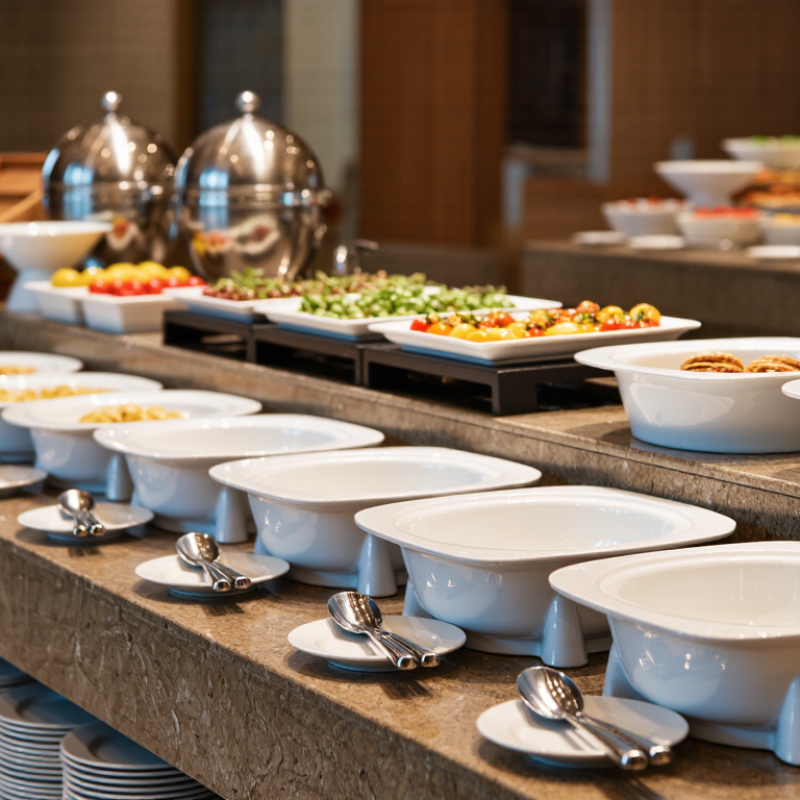
China Top 10 Buffet Porcelain Serving Ware Manufacturers?

What Defines a Leading Chinese Buffet Porcelain Serving Ware Manufacturer

A leading Chinese buffet porcelain serving ware manufacturer offers more than attractive plates. It combines stable clay formulas, controlled firing, and reliable food-contact testing. Experienced teams inspect rims, glaze coverage, flatness, and stacking strength before shipment. These details matter when serving trays face constant washing and crowded buffet lines.

Manufacturing depth also defines leadership. A dependable factory can manage prototypes, color matching, mold development, and repeat orders without losing consistency. Traceable batch records help buyers investigate chips, glaze changes, or unexpected warping. Export experience supports safer packing, clearer documents, and realistic delivery schedules. Still, no factory is flawless. A polished sample may hide production weaknesses, so buyers should inspect mass-produced pieces. I would also question unusually low prices. They may reflect thinner bodies or weaker quality control.

Tips: Request recent inspection reports, production samples, and packaging photos. Ask how defects are classified and replaced. Visit the workshop when possible. Check kiln temperature records and confirm food-contact compliance for your target market. Small tests reveal more than confident promises. Look closely.

How the Top 10 Manufacturers Are Selected and Compared

Selecting the top 10 buffet porcelain serving ware manufacturers requires more than comparing product photos. The evaluation should combine factory capacity, export performance, quality systems, and buyer experience. Grand View Research valued the global tableware market at USD 42.8 billion in 2023, showing strong demand but also intense competition. UN Comtrade data can verify porcelain tableware export activity by country and product code. These figures support screening, not automatic ranking.

Each manufacturer should receive scores for firing consistency, glaze durability, chip resistance, food-contact compliance, and delivery reliability. Factory audits should review kiln records, inspection reports, worker training, and packaging tests. ISO 9001 certification is useful evidence, but it does not prove every batch is perfect. Buyer samples should be tested for stackability, thermal shock, and repeated commercial washing. A practical comparison also measures minimum order quantity, mold fees, replacement policies, and response time. Some public reports combine porcelain with wider ceramic categories. That weakens precision, and the ranking should admit this limitation.

Tips: Request three production samples, not one. Record edge thickness and base stability. Ask for recent third-party test reports. Compare landed cost, not unit price. The best supplier may not have the lowest quotation. A slower factory with fewer defects can reduce buffet replacement costs. Sustainability should also be checked through energy data, packaging details, and waste controls, following guidance from the International Energy Agency and recognized environmental standards.

China Top 10 Buffet Porcelain Serving Ware Manufacturers

How the Top 10 Manufacturers Are Selected and Compared

The comparison framework uses six measurable procurement dimensions. Product quality and food-contact compliance receive the highest weighting, followed by production capacity, export capability, customization, and minimum order quantity. The weights total 100% and are intended for consistent evaluation across the shortlisted manufacturers without displaying individual company or brand data.

China’s Top 10 Buffet Porcelain Serving Ware Manufacturers

China’s Top 10 Buffet Porcelain Serving Ware Manufacturers

China’s leading ten buffet porcelain serving ware manufacturers are judged by more than factory size. I assessed export experience, firing control, food-contact testing, mold development, and hospitality project support. UN Comtrade data for HS 6911 shows China remained a major exporter of porcelain household tableware in 2023, with export value exceeding US$4 billion. This scale reflects strong production depth, but not every factory offers consistent quality.

A 2024 Fortune Business Insights report valued the global ceramic tableware market at approximately US$12.8 billion in 2023. It also forecasts steady growth through the decade. The strongest Chinese manufacturers usually provide vitrified porcelain, reinforced edges, chip-resistant glazing, and commercial dishwashing guidance. Their production lines may include automated forming, kiln temperature monitoring, and multiple inspection points. Details matter. A buffet platter should sit flat, even when filled with hot food.

I would not treat any top-ten ranking as permanent. Prices, kiln efficiency, export records, and testing results can change quickly. Some factories show impressive catalogs but limited evidence from real hotel projects. Buyers should request recent batch reports, thermal-shock results, glaze migration tests, and replacement policies. The China National Bureau of Statistics continues to show the importance of manufacturing and export industries, yet factory capability still requires direct verification. That is the uncomfortable part. A beautiful sample cannot prove long-term service performance.

Key Product Categories and Customization Services

China’s leading buffet porcelain manufacturers usually organize their ranges around practical service needs. Core categories include dinner plates, soup bowls, dessert plates, serving platters, sauce dishes, and portion cups.

Deep oval platters suit roasted foods, while wide trays improve presentation for salads and cold dishes. Stackable bowls save space during busy service. Small details matter.

Experienced manufacturers also develop porcelain for hotels, restaurants, catering companies, and institutional kitchens. They may offer multiple body types, including durable hotel-grade porcelain and refined fine porcelain.

Buyers should examine glaze consistency, edge strength, flatness, and resistance to thermal shock. Ask for sample testing. A beautiful piece is not automatically a reliable one.

Customization can cover shape, dimensions, glaze color, embossed patterns, logo placement, packaging, and coordinated tableware sets. Manufacturers may adjust rim width, foot-ring design, or stacking height for a specific buffet line.

Logo decoration often uses underglaze or overglaze techniques, depending on the required appearance and durability. Request decoration samples before approving mass production. Food-contact test reports and production records also support responsible sourcing.

Yet customization has limits. Complex shapes can increase breakage, and darker glazes may reveal scratches more easily. Some buyers focus too heavily on appearance and overlook replacement costs. That deserves reconsideration. A practical supplier should explain these trade-offs clearly, provide stable samples, and communicate lead times without vague promises.

Quality Standards, Export Strength, and Buyer Considerations

China Top 10 Buffet Porcelain Serving Ware Manufacturers?

For buffet porcelain serving ware, buyer evaluation should begin with measurable quality standards, not factory size. ISO Survey 2023 recorded more than 1.26 million ISO 9001 certificates worldwide. However, certification alone cannot prove chip resistance or glaze consistency. Request recent inspection records, firing-temperature data, food-contact declarations, and samples from normal production. Check the corners, foot rings, and stacking surfaces carefully. Small defects become expensive during hotel service.

Export capability also requires evidence. The WTO reported that China held about 14.2% of global merchandise exports in 2023, showing strong logistics and manufacturing capacity. UN Comtrade data for HS 6912 can help buyers compare porcelain tableware export values, destinations, and market movement. Ask each shortlisted manufacturer for shipment history, carton specifications, pallet photos, and test reports matching the actual model. A polished showroom is not enough. Incoterms, lead time, replacement policy, and packaging strength deserve equal attention.

Buyer requirements can differ sharply. A catering group may prioritize stackability, while a resort may need unusual shapes and frequent replenishment. Confirm dimensions in millimeters, usable volume, temperature limits, and decoration durability. Third-party tests can reduce uncertainty, but they also cost time. That trade-off is often overlooked. Even experienced buyers sometimes approve attractive samples without testing repeated washing or impact. A better shortlist combines production experience, transparent export records, documented quality control, and honest answers about limitations.

China Top 10 Buffet Porcelain Serving Ware Manufacturers? - Quality Standards, Export Strength, and Buyer Considerations

The profiles below are anonymized manufacturer categories for buyer comparison. Ratings indicate commonly verifiable capabilities in China’s porcelain tableware supply chain, not undisclosed company-specific claims.
Rank Anonymized Manufacturer Profile Typical Buffet Serving Ware Quality Standards and Tests to Verify Export Strength Indicators Buyer Considerations
01 Profile A
Large integrated porcelain producer
Hotel plates Platters Chafing-dish inserts Stackable bowls High-volume consistency
Food-contact testing for lead and cadmium release; glaze inspection; thermal-shock testing; dishwasher-cycle validation; ISO 9001 certification should be confirmed.
Established container-loading procedures, export carton standards, multilingual documentation, and experience with international hospitality specifications. Suitable for hotel groups and restaurant chains. Confirm mold ownership, replacement policy, color consistency between production lots, and annual audit access.
02 Profile B
High-fired hard-paste specialist
Fine porcelain plates Oval platters Rimmed dishes Verify firing-temperature control, water absorption results, flatness tolerance, edge strength, glaze adhesion, and conformity with applicable EU or US food-contact requirements. Strong for export orders requiring stable whiteness, detailed inspection reports, and repeat production over multiple seasons. A good choice for premium buffet presentation. Request sample measurements after firing because porcelain shrinkage can affect stacking and replacement compatibility.
03 Profile C
Hospitality-focused OEM factory
Hotel dinnerware Buffet bowls Serving trays Custom shapes Confirm production drawings, approved golden samples, dimensional tolerances, glaze-pinhole limits, chip-rate records, and documented corrective-action procedures. Flexible private-label packaging, OEM decoration capability, and experience coordinating mixed-SKU hospitality shipments. Best for customized collections. Agree in writing on acceptable quality limits, artwork approval, spare-piece ratios, and responsibility for tooling costs.
04 Profile D
Large-scale hotelware manufacturer
Coupe plates Stacking bowls Rectangular trays Check chip resistance, stacking stability, rim thickness, abrasion resistance, thermal-shock performance, and simulated commercial dishwashing results. Generally capable of full-container orders, standardized export pallets, barcode labeling, and scheduled production planning. Appropriate for large hospitality rollouts. Confirm minimum order quantities, lead times for replenishment, and whether replacement pieces remain available.
05 Profile E
Decorated porcelain specialist
Printed platters Logo dinnerware Patterned bowls Verify decoration placement, color tolerance, abrasion resistance, firing stability, and heavy-metal migration testing for decorated food-contact surfaces. Strong for custom artwork, hospitality identity programs, and coordinated place settings with consistent decoration references. Require signed artwork proofs and a production sample. Clarify whether decoration is under-glaze, in-glaze, or over-glaze and define permitted color variation.
06 Profile F
Mid-sized flexible batch producer
Small-batch platters Cereal bowls Serving dishes Confirm batch traceability, raw-material controls, water absorption, glaze uniformity, dimensional consistency, and pre-shipment inspection records. Flexible with mixed orders, seasonal designs, and moderate-volume export shipments; usually more adaptable than very large factories. Useful for independent restaurants and boutique hotels. Compare unit cost with mold fees, packaging charges, inspection fees, and freight efficiency.
07 Profile G
Commercial-grade durable ware producer
Heavy-duty plates Thick-rim platters Catering bowls Prioritize impact resistance, thermal-shock testing, edge-chip testing, stack-load testing, glaze abrasion, and commercial dishwasher compatibility. Well suited to foodservice distributors needing robust products, standardized cartons, and repeatable loading plans. Durability may increase product weight and freight cost. Compare breakage performance and total delivered cost rather than purchase price alone.
08 Profile H
Contemporary design-led producer
Organic shapes Modern platters Presentation bowls Confirm repeatability of irregular forms, base stability, food-contact surface smoothness, glaze coverage, and consistency between handmade-looking pieces. Strong for trend-oriented collections, hospitality concept projects, and coordinated seasonal product development. Visually distinctive shapes may stack less efficiently. Test storage, buffet handling, transport packaging, and replacement availability before approval.
09 Profile I
Export-oriented private-label supplier
Retail-ready sets Buffet accessories Gift-boxed serving ware Review factory audit results, supplier declarations, packaging drop tests, carton compression results, barcode accuracy, and pre-shipment inspection procedures. Experienced with export labeling, retail packaging, mixed-container programs, and documentation for multiple destination markets. Confirm whether production is in-house or subcontracted. Obtain written control over approved factories, materials, packaging, and change notifications.
10 Profile J
Cost-efficient standard-range producer
Basic plates Bowls Standard platters Catering sets Verify food-contact compliance, visual AQL inspection, flatness, dimensional tolerance, glaze defects, packing quality, and breakage claims procedure. Competitive for standardized designs, full-container orders, and buyers prioritizing predictable specifications and cost control. Suitable for price-sensitive projects. Avoid comparing quotations without matching porcelain grade, piece weight, packaging method, testing scope, and Incoterms.

FAQS

How should buffet porcelain serving ware manufacturers be compared?

Compare firing consistency, glaze durability, chip resistance, food-contact safety, and delivery reliability. Factory size alone is not enough. The method is imperfect.

What factory records should buyers request?

Request kiln records, inspection reports, worker training details, and packaging test results. Ask for recent records, not old promotional files. Details matter.

How many production samples should buyers test?

Request at least three samples from normal production. Check edge thickness, base stability, stacking, and surface defects. One sample is weak evidence.

What practical tests are useful for porcelain serving ware?

Test thermal shock, repeated commercial washing, impact resistance, and stackability. Inspect corners and foot rings closely. Small chips become costly.

How can buyers verify export capability?

Ask for shipment history, carton specifications, pallet photos, and model-specific test reports. Confirm lead times, delivery terms, and replacement procedures. A showroom proves little.

Should buyers choose the lowest unit price?

No. Compare the full landed cost, including freight, mold fees, breakage, and replacements. A slower supplier may reduce service losses. Cheap can become expensive.

Which product details should be confirmed before ordering?

Confirm dimensions in millimeters, usable volume, temperature limits, stacking height, and decoration durability. Written specifications prevent avoidable misunderstandings. Assumptions still happen.

How should sustainability be considered during supplier evaluation?

Request energy-use data, packaging details, waste-control records, and material information. Check whether improvements are documented. Claims without evidence deserve caution.

Conclusion

China’s leading buffet porcelain serving ware manufacturers are defined by their ability to combine reliable craftsmanship, practical design, stable production capacity, and responsive customer service. This overview explains how manufacturers can be selected and compared through criteria such as material quality, firing consistency, product variety, customization capability, delivery reliability, and experience serving international buyers. The focus is on suppliers that can support both standard collections and tailored solutions for hotels, restaurants, catering companies, and hospitality projects.

The comparison also highlights key product categories, including plates, bowls, platters, trays, serving dishes, and coordinated buffet accessories. Buyers should evaluate glaze durability, heat resistance, food-contact safety, packaging protection, quality-control procedures, export experience, and communication efficiency before placing an order. By considering these factors together, businesses can identify dependable Chinese manufacturers that offer functional, attractive, and cost-effective Buffet porcelain serving ware for different dining environments and service requirements.

Amelia

Amelia

Amelia is a professional marketing specialist with a strong understanding of the company’s products, services, and customer needs. Through her practical industry knowledge and thoughtful communication style, she helps readers discover how the company’s solutions can support more efficient,......