
Choosing the right Hospitality porcelain tableware supplier affects more than a restaurant’s visual identity. It influences service speed, guest comfort, replacement costs, and daily operating confidence. A beautiful plate is not enough. It must withstand repeated washing, hot food, sudden temperature changes, and busy kitchen handling.
Experienced buyers usually inspect more than catalog photographs. They request physical samples and examine the glaze under bright light. They check rim strength, surface consistency, stacking stability, and actual weight. A plate that feels elegant in a showroom may become inconvenient during a crowded dinner service. Small details matter.
Supplier expertise should also be measured through manufacturing records, quality procedures, and hospitality references. Reliable companies explain their porcelain composition, firing standards, packaging methods, and inspection process clearly. They should provide practical answers about minimum order quantities, lead times, customization, and replacement support. Vague promises create avoidable pressure later.
Certifications and documented testing add authority, but paperwork should not replace direct evaluation. Buyers can compare sample performance after repeated commercial washing. They can also ask how damaged items are handled during delivery. This step is often overlooked.
No supplier is perfect. Even careful purchasing teams can misjudge demand or underestimate breakage. That is why a small trial order may be wiser than a large commitment. Review the results with chefs, servers, and purchasing staff. Their daily experience may reveal problems that managers miss.
The strongest partnership combines consistent quality, transparent communication, flexible production, and dependable after-sales service. Price still matters, but the lowest quote may hide higher operating costs. A thoughtful comparison helps hospitality businesses choose tableware that performs well, looks professional, and supports service for years.
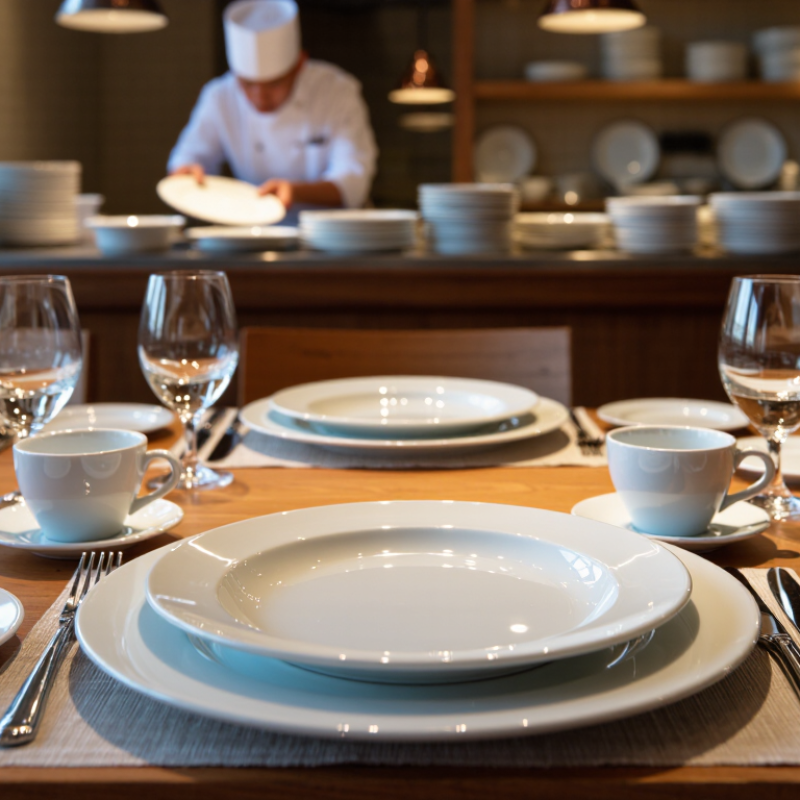
Choosing hospitality porcelain tableware suppliers starts with a clear definition of operational needs. In practical procurement, a beautiful sample can mislead. Measure the work. Record daily covers, peak-hour turnover, menu formats, storage space, and washing temperatures. A breakfast buffet may need wide plates, while fine dining may require smaller presentation pieces. The National Restaurant Association’s 2024 State of the Restaurant Industry report projected U.S. restaurant sales above $1 trillion. That scale highlights one issue: tableware must survive repeated handling, not occasional display.
Define durability requirements before discussing price. Specify porcelain body strength, chip resistance, glaze performance, stackability, and expected replacement rates. Ask suppliers for test methods, production tolerances, food-contact documentation, and dishwasher guidance. UNEP’s Food Waste Index Report 2024 estimated that food service generated 28% of global food waste in 2022. Plate size and shape can influence portions, returns, and cleaning loads. This does not mean smaller plates always work. Guest expectations still matter. Looks are not enough.
Create a simple usage profile for each outlet. Include service style, average meal duration, room temperature, transport distance, and storage handling. Request samples for a real wash-cycle trial, not only a showroom inspection. Compare ten or twenty pieces after repeated use. That is imperfect, but revealing. I would also challenge optimistic supplier claims. Ask what happens after six months, when chips appear and replacement pieces no longer match. A reliable supplier should explain quality controls, lead times, batch consistency, and corrective procedures in writing.
Assess Supplier Product Quality and Porcelain Standards
Hospital demand is becoming less forgiving. UN Tourism reported that international arrivals recovered to 99% of 2019 levels in 2024. More guests mean more plates, washing cycles, and visible wear. A supplier should provide test records, not only attractive samples. Request porcelain body composition, firing temperature, water absorption, thermal-shock results, and glaze hardness. Ask for production-batch traceability. Small details matter.
Food-contact safety needs independent verification. ISO 6486-1 evaluates lead and cadmium release from ceramic ware. The European Commission’s Joint Research Centre has repeatedly identified migration testing as a key control for food-contact materials. Ask whether testing covers the finished decoration, including colored rims and printed patterns. Confirm the laboratory’s accreditation and test date. Old reports are weak evidence.
Inspect samples after commercial washing, not just under showroom lighting. Look for pinholes, crazing, warped rims, and cutlery marks. Measure ten pieces from one carton; inconsistent dimensions can disrupt stacking and service speed. One careless sample can mislead. I have seen suppliers pass visual checks but fail after repeated high-temperature cycles. That experience deserves a correction: appearance is useful, but performance data should decide. Compare replacement rates, packaging protection, and defect allowances in writing. A cheaper unit may become expensive when breakage reaches busy breakfast service.
Choosing a hospitality porcelain tableware supplier requires more than comparing unit prices. Customization should begin with practical use. Ask for exact dimensions, glaze options, logo methods, replacement terms, and sample testing. A plate that looks elegant may stack poorly or chip beside a busy dishwashing area. I have learned this the hard way.
Design should support the dining concept, not overpower it. According to Deloitte’s 2024 travel industry research, travelers increasingly value personalized experiences. Tableware can reinforce that feeling through tactile rims, balanced proportions, and subtle color accents. However, custom shapes often increase mold costs and minimum order quantities. Good design needs restraint. Suppliers should explain these trade-offs clearly, preferably with production samples and firing records.
Product range also matters during expansion. Mordor Intelligence’s 2024 tableware market analysis identifies hospitality demand as a significant growth driver, with durability and replacement availability remaining important purchasing factors. Compare full collections, not only dinner plates. Check bowls, cups, platters, serving pieces, and compatible sizes. Ask whether future batches will match the original glaze. Small differences can become visible across a long dining table. A supplier with hundreds of designs may still lack useful depth. In my experience, a narrower range with consistent quality can perform better. Even so, I would not ignore experimental pieces; they can reveal whether the supplier truly understands service flow, storage limits, and real kitchen pressure.
Comparison of key purchasing dimensions for hospitality porcelain tableware sourcing. Scores use a 1–5 evaluation scale, where 5 indicates the strongest supplier capability.
How to read the chart: Customization measures the ability to provide bespoke shapes, sizes, colors, logos, and packaging. Design reflects aesthetic flexibility and suitability for different hospitality concepts. Product range measures the availability of coordinated plates, bowls, cups, serving pieces, and accessories.
Choosing a hospitality porcelain tableware supplier requires more than comparing catalog prices. Capacity must survive peak-season pressure. UN Tourism reported 1.4 billion international tourist arrivals in 2024, nearly returning to 2019 levels. That recovery can quickly expose weak production planning.
Ask for monthly output, kiln capacity, available molds, and documented lead times. Request a sample production schedule for 5,000 plates, not only a showroom sample. Check whether the supplier owns its kilns or relies on subcontractors. Confirm glaze consistency, edge strength, stacking dimensions, and replacement procedures for transit damage. A practical test is simple: inspect three cartons from different production batches. Small shade differences may become obvious under dining-room lighting.
Certifications add evidence, but they do not replace verification. The ISO Survey 2023 recorded 1,265,216 valid ISO 9001 certificates worldwide, showing how common quality systems have become. Still, request the certificate number, scope, issuing body, and expiry date. For food-contact tableware, obtain current laboratory reports for lead and cadmium migration, thermal shock, and dishwasher durability. Environmental certification can support responsible purchasing, yet its scope matters; a factory certificate may not cover every product line. Reliability also appears in records. Ask for on-time delivery rates, complaint-resolution times, and two recent hospitality references. A supplier may promise 98% delivery performance, but define “on time” in writing. That detail is easy to miss. Review it carefully. One overlooked assumption can turn a low unit price into costly replacement stock.
| Evaluation Dimension | Verification Metric | Recommended Evidence or Benchmark | Why It Matters for Hospitality Buyers | Priority |
|---|---|---|---|---|
| Production Capacity | Monthly output by product category | Obtain capacity figures for plates, bowls, cups, saucers, and serving pieces; confirm the figures with production records or an on-site audit. | Helps determine whether the supplier can support chain-wide rollouts, seasonal demand, and repeat orders. | High |
| Capacity Reservation | Reserved production allocation during peak periods | Request a written capacity plan showing allocated production windows, backup equipment, and escalation contacts. | Reduces the risk of delayed deliveries when hospitality demand increases or multiple properties place orders simultaneously. | High |
| Lead-Time Control | Quoted production and shipping lead time | Compare standard and peak-season lead times; require order milestones covering raw materials, firing, inspection, packing, and dispatch. | Provides a realistic basis for opening schedules, replacement planning, and inventory control. | High |
| Quality Management | Quality management system | Verify a current ISO 9001 certificate issued by an accredited certification body, including scope, sites, and expiry date. | Shows that documented processes exist for inspection, corrective action, traceability, and continual improvement. | High |
| Food-Contact Compliance | Testing for ceramic food-contact safety | Request recent laboratory reports for lead and cadmium migration. Match the test method and limits to the destination market, such as FDA requirements or applicable EU legislation. | Porcelain tableware is used directly with food and beverages, so migration compliance is a fundamental safety requirement. | Critical |
| Environmental Management | Environmental management controls | Where relevant, verify ISO 14001 certification and review controls for kiln emissions, wastewater, energy use, and material waste. | Supports sustainability requirements in hotel procurement policies and reduces operational compliance risks. | Medium |
| Product Durability | Resistance to thermal shock, chipping, staining, and repeated washing | Conduct sample testing under commercial dishwasher cycles and request applicable test reports for thermal shock, water absorption, and glaze performance. | Commercial kitchens use tableware more frequently and intensively than residential users. | High |
| Quality Inspection | Inspection stages and defect classification | Confirm inspection at forming, glazing, firing, final sorting, and packing stages; agree on acceptable quality limits before production. | Prevents inconsistent color, shape, dimensions, glaze defects, and packing damage across replenishment orders. | High |
| Traceability | Batch and raw-material traceability | Verify that production lots can be traced to firing records, glaze batches, inspection results, and shipment documents. | Enables targeted investigation and product recall instead of disrupting all locations. | High |
| Delivery Reliability | On-time-in-full delivery performance | Request at least 12 months of anonymized delivery records, including confirmed date, actual date, quantity delivered, and causes of delay. | Historical performance is more useful than a sales promise when assessing supply continuity. | Critical |
| Packaging and Transit Protection | Breakage rate and packaging validation | Review carton specifications, internal separators, pallet configuration, drop-test results, and documented transit claims. | Porcelain is fragile; poor packaging can increase landed cost and cause service interruptions. | High |
| Business Continuity | Contingency planning for equipment, utilities, and logistics | Request a documented business-continuity plan covering kiln failure, power interruption, labor shortages, raw-material disruption, and transport delays. | Identifies how quickly the supplier can recover from events that could interrupt hotel operations. | High |
| Financial and Commercial Stability | Payment terms, price validity, and continuity of supply | Review contract terms, price-adjustment clauses, tooling ownership, deposit requirements, and references from comparable hospitality projects. | Clarifies exposure to unexpected price changes, production stoppage, or disputes over molds and specifications. | High |
| Communication and Corrective Action | Response time and corrective-action effectiveness | Set service-level expectations for quotation replies, sample revisions, nonconformity responses, and replacement shipments; review completed corrective-action reports. | Fast, documented responses reduce the impact of quality issues across multiple properties. | Medium |
Note: Certification validity, laboratory reports, capacity records, and delivery data should be checked directly with the issuing body, laboratory, or supplier during the qualification process.
How to Choose Hospitality Porcelain Tableware Suppliers?
Pricing should be judged by landed cost, not the unit price alone. Request a detailed quotation covering mould fees, packing, freight, insurance, and replacement policies. Compare minimum order quantities with your actual dining volume. A low price may hide thin packaging or higher breakage rates. I once approved a cheaper offer and later paid more for urgent replacements. That mistake changed my evaluation process.
Logistics can determine whether a supplier is truly reliable. Ask for production timelines, inspection stages, loading dates, and shipment tracking procedures. For a hotel opening, even a seven-day delay can affect staff training and table setup. Confirm carton dimensions and pallet plans before ordering. These details influence storage space and handling costs. Test a small shipment first, when possible. It reveals problems that samples cannot show.
Tips: Build a simple comparison sheet. Record price, lead time, breakage allowance, response speed, and payment terms. Ask who handles damaged cartons and how quickly claims are reviewed. Good after-sales support should include clear evidence requirements and practical replacement timelines. Keep written records of approved samples and packaging standards. Do not rely on friendly promises alone. Suppliers should communicate calmly when something goes wrong. Still, my own checklist is not perfect; seasonal delays and port congestion remain difficult to predict.
Record daily covers, peak-hour turnover, menu styles, storage space, and washing temperatures. Operational facts matter more than showroom appearance.
Check porcelain strength, chip resistance, glaze performance, stackability, and expected replacement rates. A low price may hide frequent replacements.
Yes. Buffets may need wide plates, while fine dining may use smaller presentation pieces. Guest expectations still matter.
Run samples through repeated wash cycles. Compare ten or twenty pieces afterward. Inspect chips, fading, warping, and stacking.
Ask about monthly output, kiln capacity, available molds, production schedules, and lead times. Request a plan for 5,000 plates.
Inspect cartons from different production batches. Compare color, glaze, dimensions, and edge strength under dining-room lighting.
Request food-contact reports, dishwasher guidance, thermal-shock results, and quality-system certificates. Check certificate scope, issuer, and expiry date.
Review on-time delivery rates, complaint-response times, transit-damage procedures, and recent hospitality references. Define “on time” in writing.
Ask about batch records, reserve stock, corrective procedures, and replacement timelines. This issue is easy to overlook.
No. Verify claims with documents, production evidence, and wash-cycle results. No test is perfect. I would still challenge optimistic promises.
Choosing the right Hospitality porcelain tableware supplier begins with clearly defining your operational needs, including tableware types, quantities, usage frequency, style preferences, and budget. Evaluate the supplier’s product quality by reviewing porcelain materials, durability, heat resistance, glaze consistency, and production standards. A dependable supplier should offer a suitable product range, flexible customization, and design options that match your hospitality concept and service requirements.
Before making a decision, verify the supplier’s manufacturing capacity, quality certifications, inspection procedures, and delivery reliability. Pricing should be assessed alongside minimum order quantities, packaging, shipping arrangements, lead times, and the supplier’s ability to manage repeat orders. It is also important to understand warranty terms, replacement policies, communication standards, and after-sales support. By comparing these factors systematically, hospitality businesses can select a supplier that provides consistent quality, practical customization, stable logistics, and long-term value.